
Internal case study
Rambunct Consulting Ltd built Awsemble Nat, a multi-agent AWS planning assistant, with the Strands Agents SDK on Amazon Bedrock AgentCore Runtime in London. Nat holds a discovery conversation, prices an AWS estimate and sketches an architecture.
Status. Awsemble Nat is deployed in Rambunct’s own account and was exercised with test traffic in July and August 2026. It is not commercially launched, and no outside customer has signed.
The customer in this case study is Rambunct itself. Rambunct Consulting Ltd, an AWS Partner, designed Nat for its own pre-sales practice. Rambunct is both the operator and the only user group. No outside customer is named, quoted or counted, because none exists.
The challenge
Rambunct designed Awsemble Nat to give an AWS prospect the first useful answers without waiting for a consultant: what the architecture could look like, what it would cost and what happens next. The design premise was that an agent can give these answers if it is grounded and controlled.
Three needs shaped the design.
- Prospects describe their need in everyday language, and the useful answer is an architecture, a priced estimate and a next step, not a list of services.
- A cost figure is only worth giving if it is grounded in current AWS prices. A model that recalls prices from memory produces estimates that cannot be defended.
- A public conversational agent needs scope rules, protection of personal data and a human hand-off, so that it stays advisory and a person decides what follows.
This page does not claim a measured saving, because Rambunct recorded no baseline of consultant hours per prospect before Nat.
What Rambunct built
Rambunct built Awsemble Nat as a Strands Agents orchestrator with specialist agents. It runs as a serverless agent workload on Amazon Bedrock AgentCore in the London Region.
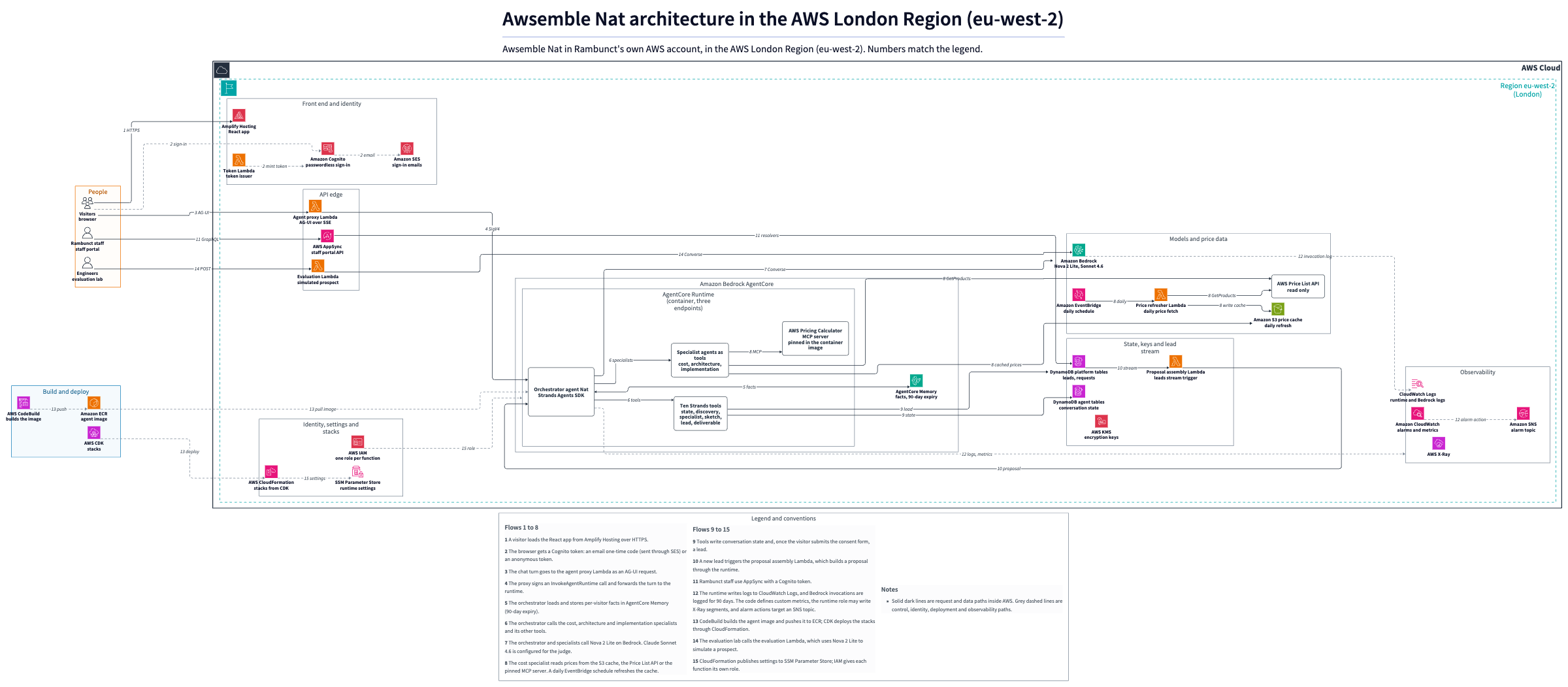
- The agent. An orchestrator agent with ten tools runs on Amazon Bedrock AgentCore Runtime, with three named endpoints. Cost, architecture and implementation specialists are called as tools.
- Memory. AgentCore Memory keeps per-visitor facts with a 90-day expiry, encrypted with a customer-managed key.
- Models. Amazon Nova 2 Lite on Amazon Bedrock runs the orchestrator and the specialists. Claude Sonnet 4.6 on Amazon Bedrock is configured for the deliverable judge and the evaluators. Nova 2 Lite is reached through a global inference profile, so model inference is not confined to London.
- Grounded prices. Cost estimates use the AWS Price List API, a daily-refreshed price cache in Amazon S3 and a pinned AWS Pricing Calculator MCP server. Checks filter out ungrounded estimates.
- Architecture sketches. Sketches are produced as a validated diagram specification and rendered by code.
- Front end. A React single-page app on AWS Amplify Hosting, Amazon Cognito sign-in (passwordless email code, plus an anonymous token) and a Lambda proxy that speaks the AG-UI protocol sit in front of the agent. Amazon DynamoDB holds leads and conversation state, and AWS AppSync serves the staff portal.
AWS services used. Amazon Bedrock; Amazon Bedrock AgentCore (Runtime and Memory); AWS Lambda; Amazon DynamoDB; Amazon Cognito; AWS AppSync; AWS Amplify; Amazon S3; AWS KMS; Amazon EventBridge; Amazon CloudWatch; Amazon SNS; AWS X-Ray; Amazon SES; Amazon ECR; AWS CodeBuild; AWS CDK; AWS CloudFormation; AWS IAM; AWS Systems Manager Parameter Store.
How it is governed
Nat stays advisory. A person decides what follows. These are the controls behind that.
- Steering handlers correct draft replies.
- A layered deliverable judge reviews each deliverable.
- Loop and cost caps limit repeated specialist calls, sketches and reply regeneration.
- A lead form records consent. The agent captures a lead only after the visitor submits that form.
- A person fulfils deliverables.
- An evaluation framework of 32 prospect personas and four evaluators backs a documented gate.
- AWS CDK defines the infrastructure. Bedrock invocation logging and CloudWatch Logs record each conversation.
Results so far
These results measure how ready the agent is and how well it performs in tests. They do not measure a business outcome for a customer.
- The AgentCore runtime, created on 13 March 2026, is READY on version 102 with three named endpoints. The AgentCore Memory store has been ACTIVE since 28 April 2026. Both were read on 3 November 2026.
- The agent code carries 2,492 test functions (counted, not run).
- The evaluation reports on file are 58 runs from 28 April to 27 July 2026. 48 passed and 10 failed against a pass mark of 0.70. The latest eight, from 20 to 27 July 2026, all passed with overall scores of 0.77 to 0.99. No report is dated after 27 July 2026.
- Awsemble Nat is deployed in Rambunct’s own account and was exercised with test traffic in July and August 2026. It is not commercially launched. No outside customer has signed.
On AWS Marketplace. Rambunct Consulting Ltd offers Awsemble to outside customers through its AWS Marketplace listing “Awsemble Managed Services“, sold through private offers. Rambunct designed Nat as the free front door of the Awsemble product.
What comes next
These steps would make Nat ready for a first outside customer.
- Label test traffic apart from real traffic before launch, so that a live lead count means outside prospects.
- Record a baseline of consultant hours per prospect and of lead response time, from the CRM, and set a leads-per-month target.
- Run a fresh evaluation against the deployed runtime version 102 and save its report.
- Have Nat present the Awsemble managed offer, which it does not do today.
- Sign the first outside customer to use Nat, with a registered AWS Partner Central opportunity and measured AWS consumption.
Talk to Rambunct
Rambunct built Awsemble Nat to be grounded in current AWS prices and controlled in scope, with a person deciding what follows.